WE SHAPE OUR BUILDINGS, AND OUR BUILDINGS SHAPE OUR FUTURE
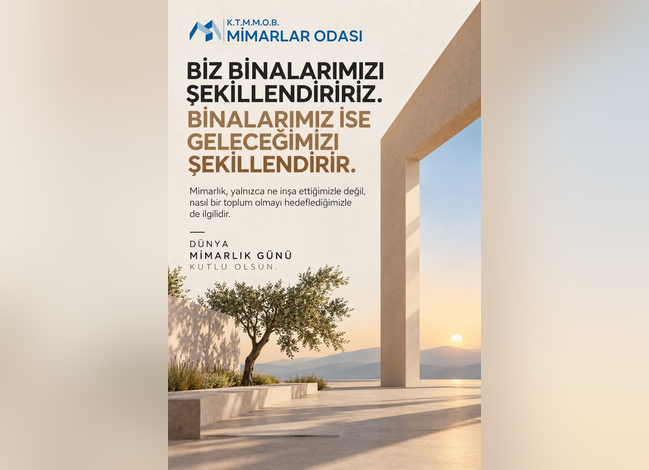
Architecture is not merely about designing and constructing buildings. It is one of the most significant instruments through which society determines the kinds of cities we inhabit, the environments in which we grow, and the country we leave behind for future generations.
We shape our buildings; yet, over time, our buildings, streets, and cities also shape our lifestyles, relationships, and ultimately, our future.
The International Union of Architects (UIA) has designated “Housing is a Human Right. Build It.” as the theme for World Architecture Day 2026. This theme serves as a powerful reminder that architecture is not simply a profession concerned with shaping the physical environment; it also carries a fundamental responsibility for the right to adequate housing, quality of life, and social well-being.
Every new building transforms its surrounding environment and the urban skyline. Every street forms part of our everyday lives. Every square, park, and public space reflects our shared values and urban culture as a society.
Therefore, the quality of architecture is not solely a concern of architects or the construction industry; it is a matter that affects society as a whole.
Quality architecture means more livable cities, healthier environments, stronger communities, and a higher quality of life for everyone.
Today, our cities face increasing pressure from rapid and often uncontrolled urban development. Evaluating construction and development solely in terms of economic value, floor area, and investment risks marginalizing urban identity, cultural heritage, the natural environment, and public life.
However, a country's level of development should not be measured merely by the number of buildings it produces, but rather by its ability to create high-quality, safe, accessible, sustainable, and people-centered living environments.
The buildings that constitute our cities are not simply economic products constructed to meet present-day needs. They are also integral components of the physical and cultural heritage we will pass on to future generations.
For this reason, safeguarding the identity of our cities, our cultural heritage, our natural environment, and our shared living spaces is a collective responsibility.
The public interest must remain at the heart of planning and development decisions. Architectural and urban planning policies must look beyond short-term economic expectations and prioritize society's long-term quality of life.
We must expand our public spaces, preserve our cultural heritage, develop cities that are resilient to the climate crisis, and create accessible, safe, and high-quality living environments for all.
Our goal should not be to construct more buildings, but to create better living environments.
Because good architecture is not a luxury.
Good architecture is not a privilege; it is a right for everyone.
As the Chamber of Turkish Cypriot Architects (KTMMOB), we firmly believe that architecture is a public responsibility that contributes to improving society's quality of life. With this conviction, we extend our warmest wishes on World Architecture Day to our fellow architects, all professionals dedicated to shaping the future of our cities, and our entire community.
May we shape our future together through a shared commitment to quality architecture.
CHAMBER OF TURKISH CYPRIOT ARCHITECTS (KTMMOB)
PRESIDENT AND BOARD OF DIRECTORS